

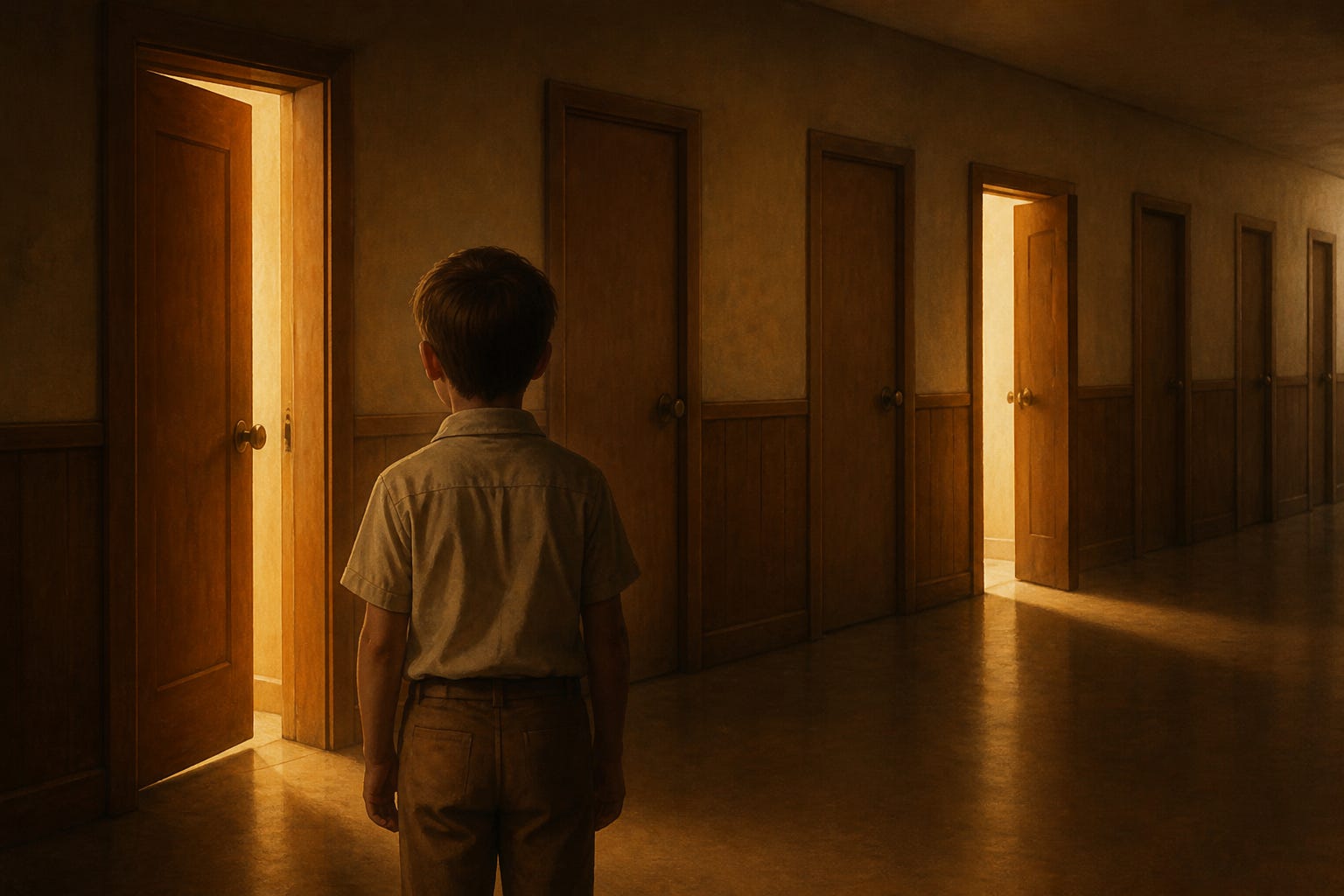
No one ever told me I couldn't own a business.
When I eventually left the military to pursue what genuinely interested me, my parents didn't openly criticize my decision. They didn't tell me I was making a mistake or withdraw their support.
But by then, I had spent years absorbing their judgments about the kinds of people and professions they respected.
That is partly what makes the influence so difficult to explain.
Growing up, my father spoke highly of military service and criticized civilians and businesspeople. Military people served others. Businesspeople cared about themselves and making money. That was the general message I absorbed.
Later, after joining the Army myself, I realized that perspective wasn't unique to him. I heard similar attitudes from other service members, particularly those who had spent much of their adult lives in the military.
There was an implied moral hierarchy. Service meant sacrifice and contribution. Civilian success, especially financial success, was easier to view as self-interest.
I wonder whether that distinction helped make the sacrifices of military life feel more meaningful. If you give something up in service of a greater purpose, the sacrifice becomes part of what makes the choice honorable. And once one path is elevated morally, the alternatives can begin to look less respectable.
I can't know how much of that was operating beneath the surface for my father or anyone else.
But I know what I took from it: money and ambition could make a person suspect, while sacrifice made a person admirable.
We develop beliefs about money and success long before we have much experience with either.
We listen to our parents talk about wealthy people, business owners, and what makes someone successful. We hear who they admire and who they criticize. Somewhere along the way, those opinions begin to influence our own.
Except they aren't always entirely our own.
The influence goes deeper than what we believe about other people. It shapes what we believe is possible for ourselves.
For much of my childhood, I had very little freedom to explore my own interests. I was required to participate in activities I hadn't chosen, whether they interested me or not.
And when I eventually began rejecting those activities and making choices for myself, those choices weren't always received well.
Wrestling was one example. My father didn't criticize my interest in it, but my mother made fun of it. She didn't like or understand it, and something I had chosen for myself became another opportunity for criticism.
That was part of the environment I grew up in. There was plenty of judgment about what people did, what they valued, and the choices they made. And when you grow up around that, you become familiar with what earns approval and what invites criticism.
I can now see how that environment shaped my choices and also what I was willing to explore and believed I was capable of.
Growing up in the 1980s and 1990s, professions like medicine, law, and engineering represented a certain level of intelligence and success. At least that was how I understood them.
But I didn't see myself as someone capable of pursuing those careers.
Nobody explicitly told me I wasn't smart enough. It was more that I never developed the belief that I was. In an environment where my abilities and personal interests weren't encouraged, I came to see certain opportunities as beyond my reach.
I remember expressing an interest in engineering and hearing something along the lines of, "That's a lot of math. You wouldn't want to do that."
It may have been an innocent comment, but rather than encouraging my interest, it reinforced my belief that I wasn't capable of pursuing it.
What I needed was the freedom to explore my interests and the encouragement to develop confidence in my abilities.
Instead, certain careers seemed out of reach before I'd ever seriously considered pursuing them.
Business was different, but the result was much the same.
It wasn't that I wanted to become an entrepreneur and believed I wasn't allowed to. I was choosing within boundaries shaped by what my parents respected and approved of. I wasn't consciously ruling business ownership out. It simply never entered my thinking as a serious career option.
So there were careers I didn't believe I was capable of pursuing, others I had learned to view negatively, and a relatively small number that seemed both respectable and realistic.
Nobody had to give me a list of acceptable professions. I already had a fairly good idea of what belonged on it.
I reached adulthood and started making my own decisions but failed to realize the boundaries I was choosing within were shaped by beliefs formed long before.
When I was 18, I wasn't consciously rejecting opportunities to become an engineer, a doctor, or a business owner.
Those possibilities weren't even part of the conversation I was having with myself.
I wasn’t simply doing what my parents wanted. That would be too easy an explanation. I made my own decisions, and there were real reasons the paths I chose appealed to me.
Aircraft maintenance interested me because I liked working with my hands. As a kid, I enjoyed building things with Erector Sets, Legos, and whatever else I could put together.
But I wasn't particularly interested in airplanes or aviation.
The military appealed to me for different reasons. It offered challenge, responsibility, the opportunity to fly, and, probably most important to me at the time, status.
Those were all things I genuinely wanted.
But I understand now that I was choosing from a menu that had already been narrowed.
The careers I pursued fit comfortably within the values I grew up around. They offered challenge, responsibility, and a kind of achievement I understood and respected.
My choices weren't necessarily wrong. They just weren't being made with a complete understanding of my own interests.
And there's another problem with choosing a career based on what it represents.
Eventually, you have to actually do the work.
As an aircraft mechanic, I was often bored and disengaged. I made mistakes I shouldn't have. That came from not being interested enough in the work to give it the attention it deserved.
Once I learned the job, much of the work itself didn't hold my attention.
I joined the Army specifically to become a pilot.
Flying had a steep learning curve, and that appealed to me. There was plenty to learn, along with the challenge, responsibility, and status that came with becoming a pilot.
The skill itself came naturally, but I never developed the same passion for aviation and warfighting that some of my peers did. They immersed themselves in the details, studied beyond what was required, and genuinely loved the mission and lifestyle.
I worked hard and studied diligently, but I didn't share their enthusiasm. For a long time, I couldn't understand why. Becoming a pilot was something I had genuinely wanted, and I'd worked hard to get there.
But wanting to become something and enjoying the experience of being it are two different things.
Eventually, I found myself dreading Monday mornings and living for Friday. I remember standing in PT formation at Fort Riley, Kansas, at 6:30 one winter morning. It was dark, below freezing, and, as usual the wind was blowing around 30 miles per hour. I stood there absolutely hating my life.
It wasn't exactly how I'd imagined life as a pilot.
Both aircraft maintenance and flying offered good experiences, but for me the work eventually became too defined.
Once I understood the system and became competent within it, there wasn't enough left that kept my attention and interest.
The challenge of becoming something had attracted me more than the experience of being it.
Of course, recognizing that didn't mean I suddenly knew what I wanted to do instead.
Leaving the military gave me the opportunity to choose a different direction, but it wasn't as though I had spent years quietly developing a perfect alternative plan.
I was still figuring out what interested me.
My first move into business was residential real estate sales.
I got my sales license and was determined to make it work. I was even beginning to have some success.
There was just one problem. I privately hated it.
Once again, I found myself dreading Monday mornings.
Some of that was the work itself. A lot was the environment around it. The people, culture, and lifestyle surrounding residential sales weren't particularly appealing to me. I started looking for another direction.
That search eventually led me to a master's program in real estate development.
Development felt different.
Every project was its own problem. There were new things to learn, disciplines to understand, and opportunities to work with experienced professionals whose knowledge and perspectives I appreciated.
There wasn't a point where I could simply learn the role and repeat it indefinitely. The problems kept coming, and they kept changing.
Over time, I began to recognize the pattern.
What held my attention wasn't aviation, real estate, or even business as a category.
It was learning, creating, and solving problems.
My experience in sales was useful because it showed me what didn't fit.
Trying something and discovering what you don’t want isn't necessarily a wrong turn. Sometimes it's the only way to find out.
And choosing for yourself doesn't automatically make you good at choosing.
For much of my childhood, other people had decided what I should pursue. When I began making my own choices, those choices could invite criticism. And as I got older, I carried forward some of the judgments I'd grown up around, including assumptions about what I was capable of and what kinds of careers were worth pursuing.
I had become good at working toward difficult goals, but I hadn't spent nearly as much time exploring my own interests without all those other considerations mixed in.
That didn't change overnight.
I began making more authentic decisions, but my beliefs about what was respectable, worthwhile, and worthy of approval still shaped the paths I considered.
I had to learn what actually sustained my interest and I did so by trying different things. Some worked. Others didn't. Each experience helped me understand a little more about what I wanted.
I don't know whether I would have enjoyed engineering, medicine, or any of the other careers I never allowed myself to consider. Maybe I would have. Maybe I would have discovered pretty quickly they weren't for me. I know now that I was smart enough and capable of pursuing them, but I never gave myself the opportunity to find out.
I thought finding the right career was a matter of making the right choice. What I failed to recognize was how the beliefs I'd absorbed growing up shaped my understanding of what was possible for me.
Ironically, the interests I eventually found most fulfilling had been there all along.
As a kid, I started a lawn-mowing business, picked potatoes and sold them door to door, and baked cookies to sell at school. I enjoyed building businesses and finding ways to create something of my own.
Yet when it came time to choose a career, becoming an entrepreneur wasn't something I seriously considered.
I was naturally drawn to those things. I just hadn't recognized them as possibilities for my future.
There's an old adage I used to think sounded nice but wasn't particularly realistic: "Do what you love, and you'll never work a day in your life."
I keep discovering unexpected depth in familiar sayings, and this is one of them.
Work is work. You find a decent job, earn a living, and hopefully retire with enough time, money, and health to enjoy a few years before you die.
Many of us grew up around expressions of similar ideas about work and developed beliefs that reflected them.
But I've come to understand the saying differently.
Our natural interests and abilities begin showing themselves in childhood, long before we're thinking about careers. Given the freedom, support, and encouragement to explore them, we have an opportunity to discover what genuinely engages us.
That doesn't mean every childhood interest should become a profession. But those interests can tell us something about the kind of work we might find fulfilling.
For me, that turned out to be learning, creating, and solving problems. I eventually found those opportunities in real estate development and entrepreneurship, but I'd been drawn to them since childhood.
Hustle and grind is work.
When you're genuinely drawn to something, action comes naturally. The effort is energizing and enjoyable because it's an authentic expression of your unique self.
That’s what “never working a day in your life” means.
From the outside, it might look like you're working harder than ever. And in some ways, you are. But what makes something feel like work isn't the effort it requires, but your relationship to what you're doing. The same activity that feels like an obligation to one person can be a source of enjoyment to another.
That brings me back to what was missing in my childhood.
I didn't need someone defining my future for me. I needed the opportunity and support to discover who I already was and where my interests might lead.
I believe that's one of the most important responsibilities of parenting: helping our children discover and develop who they already are.
I spent years trying to become the person I believed I needed to be. It took me much longer to discover who I really am.
Related Essays
Actions, Not Outcomes
What chasing a win taught me about the difference between a goal and an expectation.
The Cost of Belonging
An earlier lesson that approval came with conditions, and how I learned to read every group before joining it.