

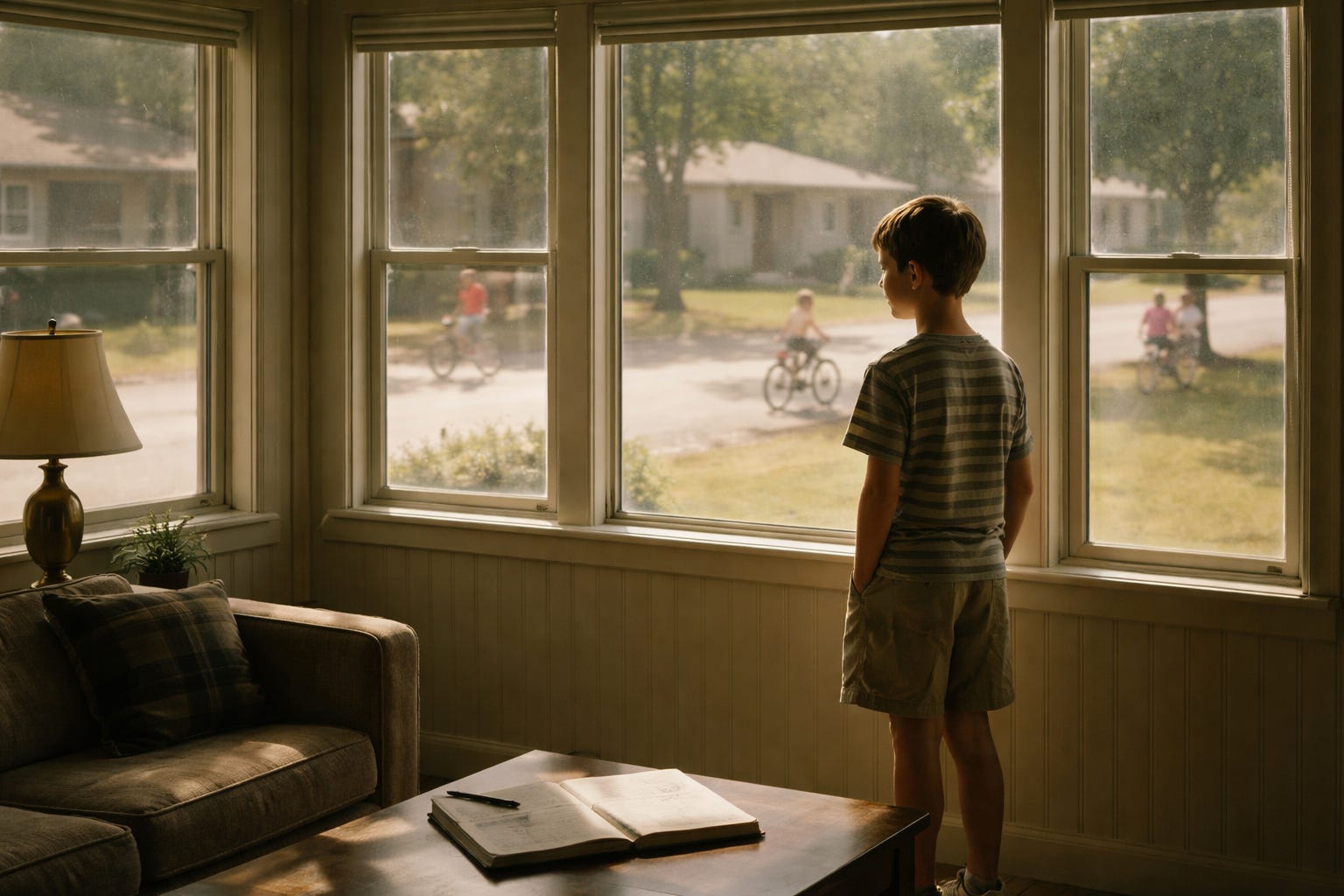
It was summer on Barksdale Air Force Base in Louisiana. I was ten.
On base, summer was unmistakable. The air was thick. Screen doors slammed. Bikes scraped across pavement. Kids ran between houses in loose groups, calling to each other from yard to yard.
Inside our house, one room was always the school room.
In that house, it was the sun room.
The windows wrapped around three sides. Light came in hard and bright. You could hear everything from outside more clearly than in the rest of the house. The sound carried straight through the glass.
Outside, summer moved without me.
I could hear it clearly. I wasn’t part of it.
Inside, the sun room stayed bright and still.
There was a couch along one of the walls. We were not always at desks. That detail was presented as something we should appreciate. Other kids sat in classrooms. We could do math on a couch.
The school planner sat on the table.
It was written in careful handwriting. Each assignment recorded. Each page number tracked. Notes about what had not been completed.
According to the planner, we were behind.
Summer did not begin when other schools let out. It began when the planner said we were finished.
The planner rarely said we were finished.
Kids were playing. I could hear them laughing, see them riding past the house, stopping in the street to talk. Sometimes they knocked on our door.
I wanted to go more than I could explain.
They asked why. I didn’t have a good answer. We were behind. We were catching up. We weren’t done yet.
That explanation never made much sense when spoken.
The knocks came less often.
Eventually, they stopped.
We were still in the sun room.
Some mornings we started early. Others we did not. Some lessons required guidance that was not always there. The pages waited.
The planner did not record the waiting. It recorded only what remained undone.
One school year ran into the next, always beginning behind.
After a while, I stopped expecting effort to change it. Beginning behind meant staying behind.
It stopped feeling temporary.
When my dad asked why we were still inside, the planner came out. It showed what had not been done. It showed how far we had to go.
When I was younger, I thought he might close it and send us outside anyway.
By then, I mostly waited for it to be opened.
Once it was on the table, the conversation narrowed.
The planner decided.
There was no further appeal.
The kids outside kept riding their bikes.
Inside, the sun room stayed bright and unchanging.
At some point, I stopped expecting change.
The Structure
The room was small. The system inside it was not. The planner provided documentation. It created the appearance of order. On paper, progress could be measured. Assignments were tracked. Gaps were visible.
But the execution of that order depended on children managing their own completion.
The expectation was discipline. The mechanism relied on self-discipline from those who did not yet fully possess it. It also depended on consistency. Some days were structured. Others were not. The expectations remained, but the conditions around meeting them shifted.
When work was not completed, the debt was recorded. The record then determined whether permission was granted. The same metric that defined progress also controlled access. The balance rarely returned to zero.
Responsibility and authority operated in different places.
It functioned as though completion were purely a function of effort.
Over time, the outcome became predictable.
Beliefs in Play
Repeated action implies a belief that makes it logical.
The planner recorded what was unfinished. It did not record waiting or inconsistency. For that to feel appropriate, measurable output would need to define responsibility. If something remained undone, the cause was presumed to be effort.
The structure also operated as though discipline created safety. Authority set the standard. Execution belonged to the child. If performance lagged, the response was pressure, not revision of the metric. The ledger clarified standing. It did not reset.
Inside that system, my own beliefs began forming.
If beginning behind often led to staying behind, one conclusion followed: effort did not reliably change outcome. If permission depended on a record that did not clear, access felt conditional and fragile.
Over time, that belief refined itself.
Effort was worth investing only where outcome was influenceable. Authority that did not respond to feedback could not be relied upon. Stability had to be internalized. Exposure carried risk in environments where standing could shift without notice.
The enforcement made sense if output defined responsibility. The pressure made sense if deviation created risk. My adjustment made sense if effort did not reliably change outcome.
What Formed
Beliefs do not remain abstract. They express themselves in decisions.
If effort is only worth investing where outcome is influenceable, then energy becomes selective. In school, I invested heavily where grading felt merit-based and disengaged where it felt arbitrary. In adulthood, entrepreneurship offered clearer leverage than hierarchy. Strategic energy allocation became an advantage. Patience inside imperfect systems shortened.
If authority without responsiveness is unstable, then inconsistency triggers reaction. Shifting expectations reduced trust. Clearly defined agreements built it. This sharpened negotiation and contract discipline. It also shortened my tolerance for environments that required endurance over correction.
If stability must be internalized, control becomes central. Strategy replaced appeal. Planning replaced hope. Ownership felt safer than dependence. This built autonomy and leadership capacity. It also made collaboration slower when trust had not yet formed.
If exposure carries risk in unstable systems, emotional containment becomes rational. In conflict, I often reduced visible resistance or conserved energy in low-leverage domains. That preserved focus. It also limited vulnerability where it might have strengthened relationships.
These patterns were not accidental.
They followed the logic of the room.
Integration
Awareness does not erase early beliefs. It refines them.
I have learned that effort can change outcome in relational environments that allow feedback. Not every system is closed. Some adjust. Some respond. The belief that effort is futile has narrowed into a more precise one: invest where influence exists, but do not assume futility prematurely.
I have expanded tolerance for imperfect systems. No structure is neutral. Institutions protect themselves. Expectations are clearer when that is understood. Strategy becomes more informed and less reactive.
Conflict has required the most revision. In earlier environments, escalation carried risk. In professional life, productive disagreement is often necessary. My body still reacts quickly. The impulse is decisive. Learning to regulate that response without suppressing clarity remains ongoing work.
The beliefs that formed in that room built strengths: strategic thinking, ownership, autonomy, leadership. They also built reflexes that required examination.
The room has not changed in memory.
The meaning of it has.
This is a sharp execution of your stated framework from a lived event to structural environment to belief consolidation to adult patterning. The analytical distance is impressive.
One suggestion: consider adding a slightly clearer hinge between narrative and abstraction. A brief reflective transition could make the architectural shift feel more intentional and less abrupt.