

We had just moved again.
My dad was in the Air Force. Moving was normal. This one came the summer before my senior year of high school.
By then I understood something about our house.
Being idle was noticeable.
If I was watching television or sitting around too long, it drew attention. Questions followed. What had I done that day? What had I accomplished? What had I been working on?
Productivity mattered.
The problem was that we had just arrived.
It was the middle of summer. School hadn’t started. I didn’t know anyone. I didn’t even know where to look.
Most of that day I had been in the house.
Watching television.
Waiting for something to begin.
My dad came home from work that evening.
He was in the bedroom. I stood in the doorway while he asked what I had been doing all day.
Watching TV was not the right answer.
Why wasn’t I out doing something?
Why wasn’t I trying to meet people?
The questions came as criticism, not curiosity.
We had just moved.
I didn’t know anyone.
I tried to explain that.
The frustration was building. I could feel the emotion rising and tried to force it back down. Crying would only make things worse in that room.
It slipped through anyway.
My lip quivered, my voice tightened, my eyes filled with tears.
He mocked it.
He pulled his face into an exaggerated crying expression, bouncing his shoulders and making the sound.
“Hmm. Hmm. Hmm.”
For a moment I just stood there.
Then something in me snapped.
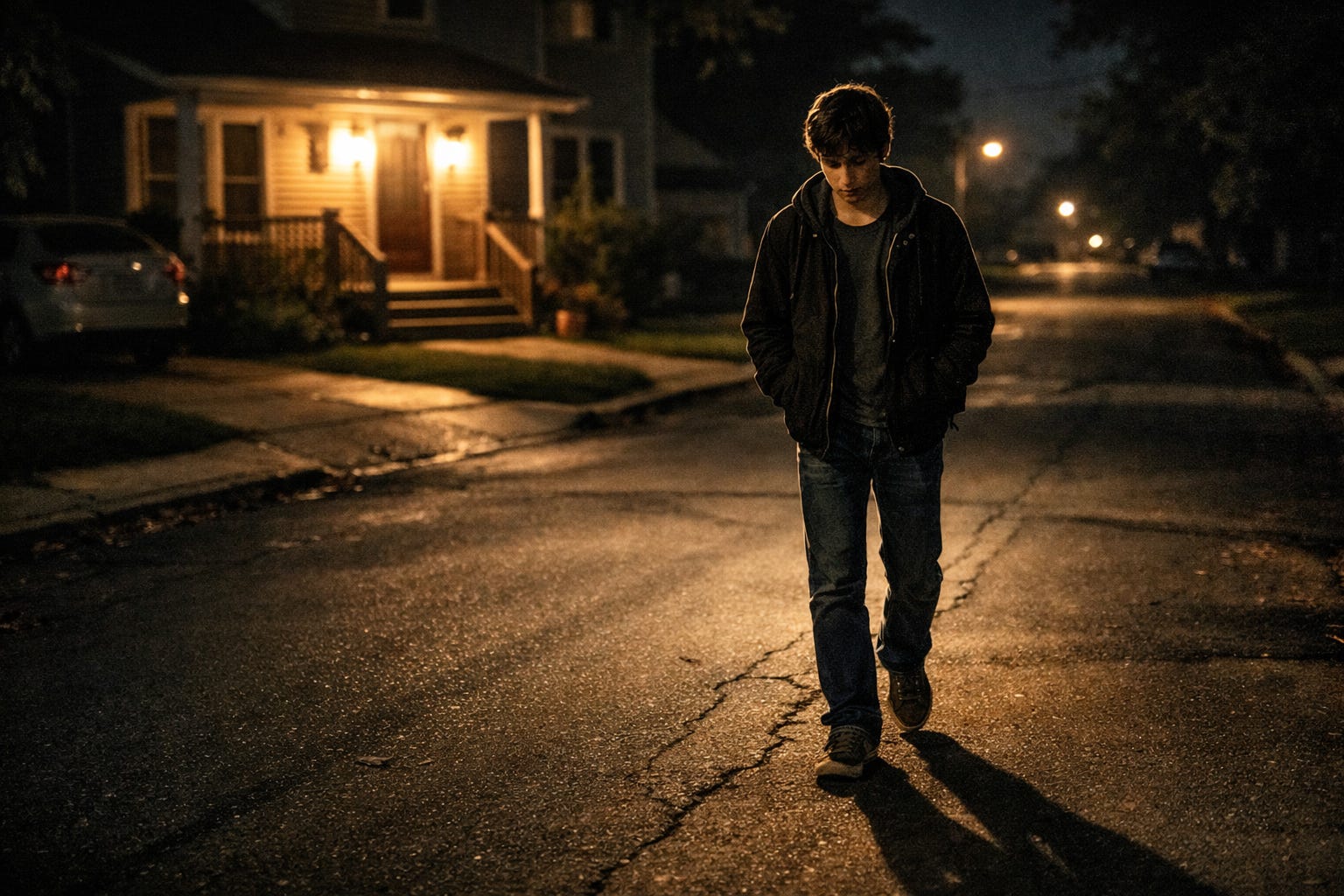
I turned, walked out of the house, and slammed the front door as hard as I could behind me.
I walked to a small playground in the neighborhood.
It was dark by then.
No one else was there.
I sat on the metal equipment and stayed there for a while, replaying the moment over and over.
The conversation.
The crying.
The mocking.
The anger stayed close to the surface.
I had tried to explain the situation. I had tried to hold the emotion back. None of that had mattered.
What stayed with me most wasn’t the criticism.
It was the mockery.
Something about that moment settled into place while I sat there.
If emotion could be used against you that easily, it made sense to remove it from the equation.
I didn’t say it out loud.
But the decision was clear.
I would not give anyone that again.
The Conditions
Over time, the emotional system of the house became predictable.
Emotion did not move easily in that environment. That didn’t mean we never felt it. It meant there was little space for it once it appeared.
Most of the time the response was dismissal.
If something upset me, explaining why rarely changed the direction of the conversation. The explanation was often treated as an excuse. The focus returned quickly to what should have been done differently.
If the emotion continued, irritation could follow.
The expectation was control.
Showing frustration rarely improved the situation. It usually narrowed the conversation.
That pattern existed alongside another structure that had already taken shape in the house.
Idle time drew attention. Productivity provided insulation. Visible effort created standing. That system organized how responsibility was evaluated.
A version of that structure had appeared years earlier in The Card Catalog, where visible effort carried its own kind of protection.
Emotion complicated it.
Productivity could be seen. Effort could be measured. Emotion was harder to contain.
In environments where discipline and decisiveness carry value, that kind of disruption can feel unnecessary.
Dismissal restores order quickly.
Control restores it faster.
What Would Need to Be True
For a system like that to remain consistent, certain assumptions would likely need to be operating beneath it.
The late 1990s were not a time when emotional expression in men was widely encouraged. In many environments, restraint was associated with maturity. Visible emotion could easily be interpreted as weakness.
My father spent his career in the military.
In that environment, discipline is not simply preference. It becomes identity. Composure signals control. Standards signal strength.
Emotion complicates that equation.
Frustration, sadness, or vulnerability introduce ambiguity into moments that have already been judged. In environments built around discipline and authority, that kind of disruption can feel unnecessary.
Another assumption may also have been present.
Circumstances did not appear to reduce expectations.
We had just moved. I didn’t know anyone yet. But the difficulty of that transition did not change the standard being applied.
If resilience is the primary value, empathy can begin to look like accommodation. The situation may be difficult, but the expectation remains the same.
The problem exists. The responsibility is to solve it. Emotion does not move that process forward.
Dismissal restores order quickly.
Stronger responses restore it faster.
What Formed
Beliefs rarely appear all at once. They form through repeated exposure to the same pattern.
Over time certain conclusions began to settle in. One of the clearest involved explanation.
I was often asked to explain myself. But the explanations rarely changed the direction of the conversation. They were interpreted as excuses.
If explanations do not alter judgment, the incentive to offer them begins to fade.
Situations could also shift quickly from explanation to moral framing. That dynamic also appears in The Walk, where a simple mistake became evidence of something larger.
Another belief formed from moments like the one in the bedroom doorway.
Showing emotion created risk.
In that moment the frustration I was trying to explain became the focus instead of the situation that caused it. The emotion did not clarify anything. It created vulnerability.
The response skipped anger and went directly to humiliation. Anger communicates that you did something wrong. Humiliation says you are weak.
That pattern supports another conclusion: visible emotion can be used against you.
The most reliable protection is to remove it from the situation entirely.
So I did.
I didn’t learn to control emotion. I learned to keep it away.
Another belief formed alongside that adjustment.
Circumstances did not change expectations. Difficulty did not reliably produce grace. If a problem existed, responsibility for solving it began immediately.
The safest position inside a system like that is simple.
Do not rely on explanation.
Do not expect empathy.
And do not show the emotion someone else might use against you.
How It Shows Up
Beliefs formed in one environment rarely stay there. They travel forward and attach themselves to new situations.
The rule about explanation followed me into adulthood.
When I am asked to justify a decision or explain my reasoning, something physical happens first. My body reacts before my mind finishes processing the question.
My voice tightens. My breathing changes. Sometimes my hands or lips begin to shake.
Externally, I stay calm.
Internally, a different calculation is happening.
Part of my attention shifts to whether the reaction is visible.
That awareness of reaction was not limited to conflict. A similar kind of monitoring appeared in The Flat Top, where autonomy carried the risk of disrupting connection.
I wonder if they can hear it in my voice. If they can, it feels like a loss of composure.
And composure affects persuasion.
If the emotion becomes noticeable, it risks weakening the argument. In environments where control communicates credibility, that signal can feel costly.
So the focus shifts.
Instead of simply explaining the reasoning, energy moves toward defending the position. The goal becomes preventing the moment from turning into something else.
The reaction is not always logical in the present situation. But it follows a pattern learned in a different environment.
When explanation once led to dismissal, the body learns to prepare for dismissal again.
What Remains
Patterns formed early rarely disappear completely. More often they become visible.
The reaction that appears during moments of explanation did not develop randomly. It formed in environments where explanation rarely changed judgment and emotional exposure created vulnerability.
Understanding that origin changes the experience of it.
Before that awareness, the reaction simply felt like part of my personality. The physical response during moments of conflict or explanation felt automatic and confusing.
Now the pattern is easier to see.
Instead of interpreting the reaction as identity, it can be understood as adaptation.
Adaptations can be adjusted.
Experience has helped the most. Over time I’ve had more conversations where explanation actually mattered and reasoning was evaluated on its merits. Confidence grows in environments like that.
Preparation helps as well. When I walk into a discussion with clear facts and structured reasoning, the focus stays closer to the argument itself.
The reflex still appears more often than I prefer.
My voice may tighten. Adrenaline can arrive before the conversation has fully unfolded.
What has changed is the response to it.
Awareness creates distance between the reflex and the outcome.
The goal is no longer to eliminate the reaction.
It is to keep it from deciding what happens next.
Progress, in this case, looks less like removal and more like influence.
Understanding the pattern makes that influence possible.
Related Essays
The Walk
A small mistake becomes moral evidence, revealing how explanations could quickly turn into judgment.
The Flat Top
An early lesson in autonomy and connection, where independence carried the risk of disrupting emotional balance.
The Card Catalog
An earlier memory where productivity and visible effort functioned as protection.
You put it very nicely. Helpful!