

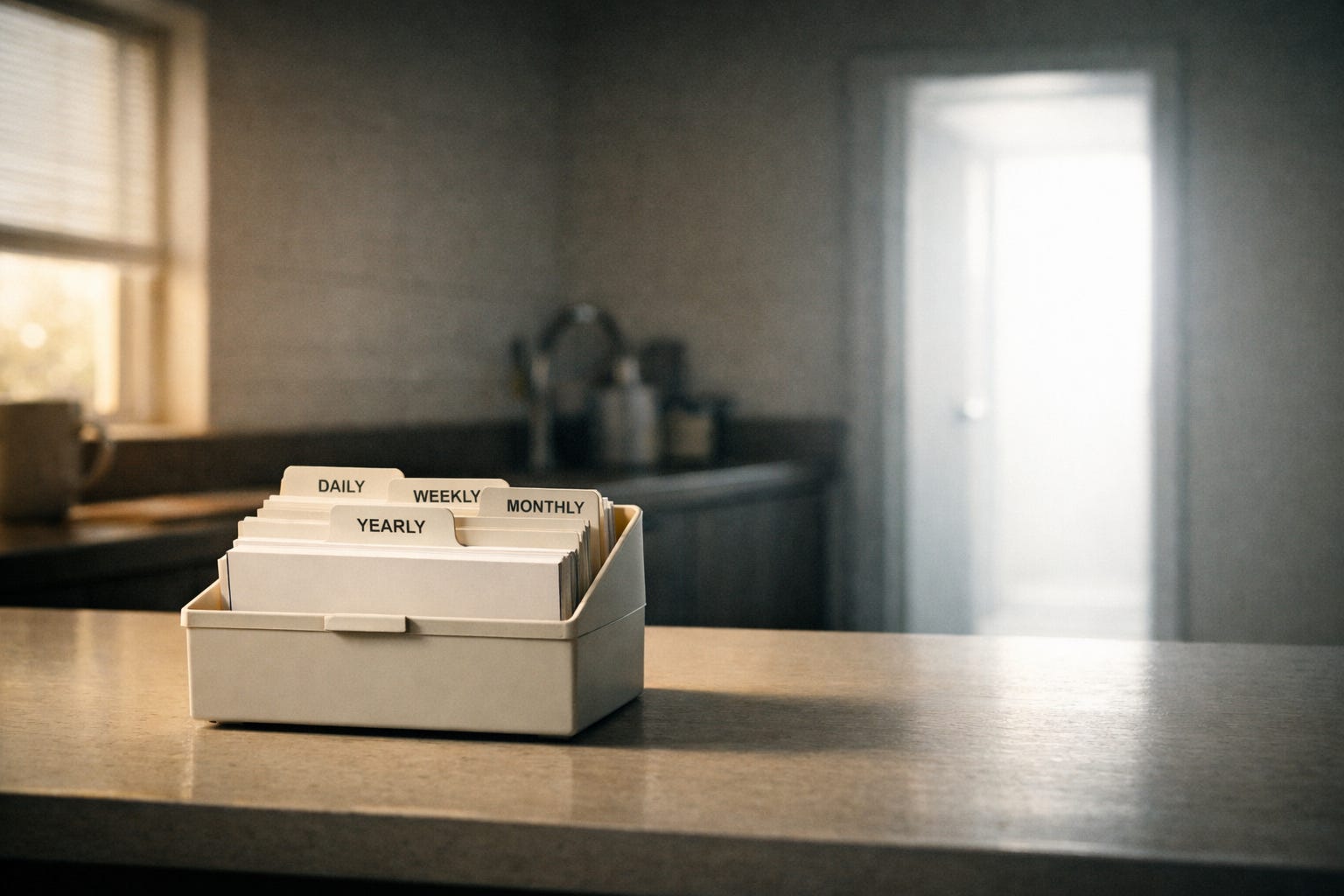
The card catalog sat on the kitchen counter.
Index cards separated by labeled dividers: daily, weekly, monthly, quarterly, yearly.
Each task handwritten in careful print.
You could flip through it.
The categories were clear.
Responsibility clearly established.
We didn’t use it every day.
It stayed on the counter. Present. Structured. Available.
If something hadn’t been done, it could be referenced.
There were parts of the bathroom that were mine.
Not the whole room. Certain surfaces. The toilet. The tub. The sink. I don’t remember exactly which parts, only that some portions carried my name.
I would clean it.
I remember finishing.
And then I remember it not being finished.
I was young, maybe seven, maybe eight.
I was asleep.
I remember being pulled out of bed.
There wasn’t a gradual waking. Just movement. My feet on the floor. The hallway. The bathroom already lit.
The overhead light was harsh. My eyes hadn’t adjusted. Everything felt exposed.
My dad was furious.
Not measured. Not controlled.
His voice filled the room before I understood what was happening.
The bathroom wasn’t clean enough.
I wasn’t asked anything.
There was no space to respond.
I remember trying to locate the problem. Trying to understand what part of the room we were looking at.
Something had been missed.
I was crying before I was fully awake.
Not arguing. Not defending.
Crying and cleaning.
He stood there towering while I wiped at whatever he pointed to.
I don’t remember what changed between unacceptable and acceptable.
I remember wanting it to stop.
Eventually, he left the room.
The light was still on.
I turned it off and went back to bed.
That night was not a rupture.
It followed a familiar hierarchy.
“Not clean enough” was not unusual. It was part of the daily evaluation.
Most of the time, it ended with correction.
Sometimes it escalated to my dad.
Less often, it culminated in fury.
The bathroom was not exceptional.
It was simply one instance where the pattern became unmistakable.
Conditions of Completion
What “enough” meant was not clearly defined. There was no fixed point that secured the result.
It could always be cleaner. I tried adjusting. Cleaning longer. Looking closer.
The outcome didn’t change. Eventually, I adjusted something else. My expectations.
The system itself suggested that tasks had boundaries. Daily chores could be done. Weekly responsibilities could be checked off. The structure implied that effort moved you toward stability.
But the lived experience operated differently. A task could be completed and still be insufficient. A surface could be wiped and still be revisited. The standard was visible, but the threshold was not.
“Enough” was a judgment, and judgments could shift.
Responsibility was clear. Control was not. I was accountable for completion, but I did not define what completion meant.
Effort did not create resolution. At best, it produced silence. At worst, it triggered correction. There was rarely a clear moment where something moved from evaluated to settled.
What Would Need to Be True
For a system like that to remain intact, certain assumptions would likely need to be operating beneath it.
My mother created the card catalog system.
For her, order may have carried more than practical value. If things fell out of order, judgment may have felt likely, not from the outside world, but within the house. And if judgment felt close at home, standing could feel fragile. In that framework, order is not preference. It is protection.
Visible competence may have functioned as insulation. A categorized system, documented chores, and high standards create defensibility. If everything is accounted for, criticism has less room to land.
When worth becomes closely associated with environment, control of the environment can begin to feel necessary.
For my father, a different belief structure may have been active beneath the enforcement.
Weakness may have felt costly. Discipline may not have been simply a preference, but an identity marker. Standards signal strength. Decisiveness signals control.
If expectations softened, authority could appear to soften with them. And if authority softened, standing may feel less secure.
In that framework, correction is not cruelty. It is reinforcement. Order must be maintained. Authority must remain visible.
Conditions of Safety
I learned that safety did not come from being finished. It came from being visibly productive.
If disorder invites judgment and authority must remain decisive, then completion alone is not enough. What matters is evidence. Movement. Output that can be seen.
Safety requires visible output.
If I am producing, I am defensible. If I am not, I am exposed to evaluation.
Rest, in that framework, becomes complicated. Not because rest is wrong, but because when nothing is being produced, there is no visible proof of competence. Without visible proof, security feels less stable.
Over time, safety stopped being something assumed and became something maintained.
How It Shows Up
Beliefs do not remain abstract. They organize behavior.
If safety requires visible output, then productivity becomes stabilizing. Creating restores control. Movement produces validation. Work becomes both evidence and insulation.
Over time, I gravitated toward producing rather than consuming. I run instead of play. I create instead of watch. Even my leisure trends toward exertion rather than idleness. Four hours moving feels justified. Four hours playing does not.
From the outside, it looks disciplined. Focused. Driven.
From the inside, it began as insulation from criticism.
When I am publicly productive, I feel validated. In control.
When I am publicly idle, something more subtle appears. Not panic. Not collapse. But exposure. A sense that stillness removes evidence.
So, rest shifts location. It moves into private space. Recovery happens quietly. I recharge alone, where nothing needs to be demonstrated. Where output is not being measured.
The work remains visible.
The restoration remains unseen.
That is how the belief expresses itself.
How It Functions Now
The urge to produce has not disappeared.
If anything, it remains strong.
The difference is awareness.
I can see the belief beneath it now. I understand where it formed. I understand what it was protecting. It did not start as ambition. It was insulation.
There was a time when productivity felt compulsory. Rest felt unjustified. Finishing something rarely felt complete. That pattern could be exhausting because it was defensive. It was driven by the need to stay ahead of evaluation.
Now it functions differently.
I still produce. I still build. I still move. But it no longer feels like protection from collapse. It feels like expression.
The awareness changes the posture. Mistakes are no longer evidence of exposure. They are part of the process. If you are building publicly, judgment is inevitable. That is not a threat. It is the cost of creation.
The feeling of being judged does not disappear. It likely never will. But it no longer dictates direction.
Productivity is now a strength I lean into deliberately rather than a pressure I submit to unconsciously.
There are still moments when rest feels unfamiliar. When stillness brings a flicker of unease. But I can recognize it as residue rather than instruction.
The same system that once made completion unstable also trained attention to detail. It built endurance. It sharpened discipline. It created the capacity to build things that last.
Those traits are not accidents.
They were developed in an environment where output felt tied to safety.
Now they are tools rather than shields.
I create because I choose to create. I build because I value building. I teach my daughter that effort is valuable and mistakes are proof you’re trying. That rest is not weakness. That completion is allowed.
The finish line doesn’t move unless I move it.
Your reflection on the card catalog reveals how order can be a shield rather than just a tool, transforming productivity into a survival mechanism.
Great to have your voice here, Ryan. Subscribed and looking forward to more. I would love you to do the same, if my writing resonates.